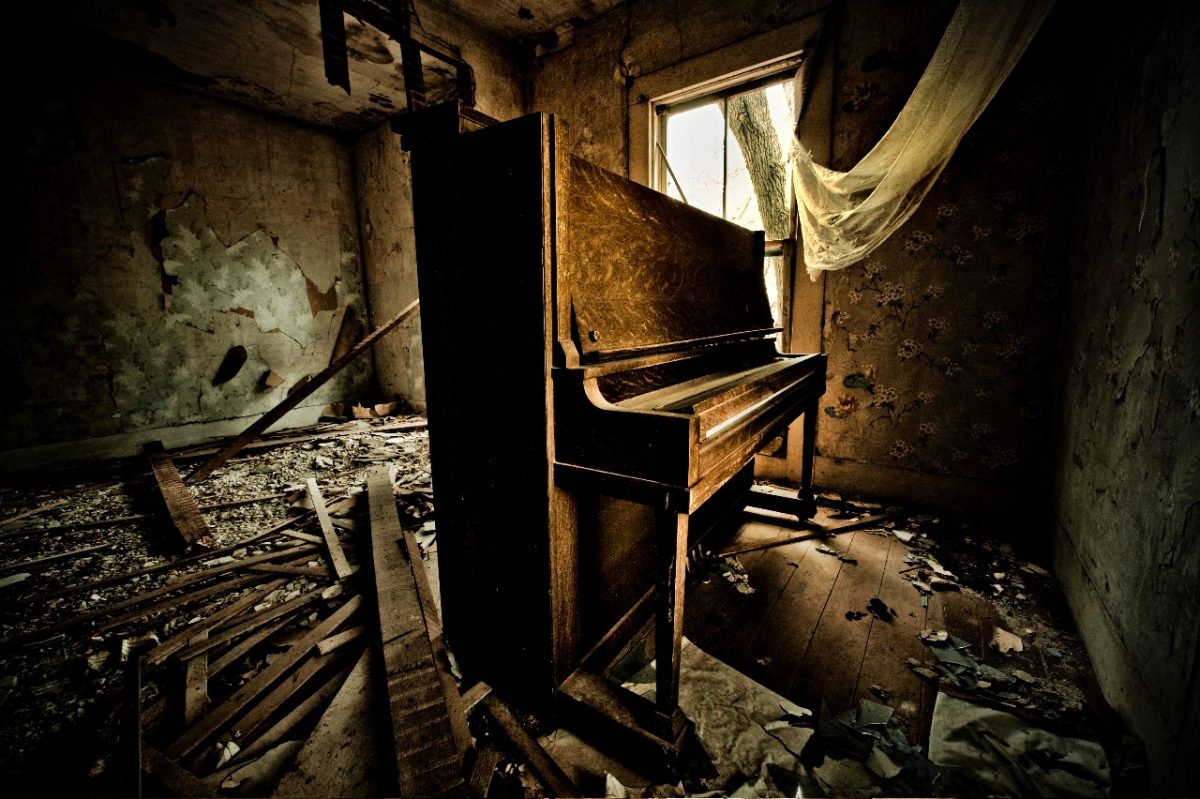
The old man was singled out by the crowd at a family get together. He was dressed in bib overalls, worn T-shirt, and a past prime denim cap. A hard-working farmer. It showed. The crowd urged him on.
“Come on old man, play!”
I was young and didn’t understand what they wanted him to do. Play … play what?
BRING IT OUT
“Do it old man, Bring out the third hand.”
The man had a small farm – 125 acres – worked it hard. But farming wasn’t doing well, so he also worked at the General Motors auto plant in Norwood, Ohio.
It was a small farm. But he was a big man. To me a giant. Powerful, mean-looking, grizzled, crusty and always dusty.
“Come on old man! What’s it been? Thirty years?
THE RIVER LETHE
The old farming autoworker was into his 3rd drink now. Three more than he usually permitted himself. Why? Because he worked 18-20 hours a day, six days a week.
Drink to him, he explained once to me, “was like crossing the river Lethe.”

I had no idea what he meant; I was only 7-years-old. The creek next to my house was a river to me.
THE LURCHUFFLE
People liked to watch him walk. He didn’t really walk, though. It was more like a lurch, followed by a shuffle. Later, when he’d crossed the “Great Divide,” the family would chuckle about his lurchuffle.
The old man lurchuffled forward, and the gathering quieted. I couldn’t see much because I was so small, but I could see that he had sat down.
A MAPLE LEAF RAG

The next thing I heard was music. Ethereal, rhythmic, syncopated. An orchestral-like piano started slowly, then swelled like an archetypal story, a Heroes Journey of musical resonance. Powerful. A force you could feel.
The people roared approval.
I felt a loving hand grasp my arm and whisper in my ear.
“Your grandpa has the magic. When he used to play people called him The Third Hand because no one person could match him – could sound like there were three hands playing. It’s an aural effect where two sounds combine – in harmony – and create a third, but different sound.”
“I never knew Grandpa could play. How did he…”
“He was a traveling roadshow piano player. Played at Coney Island and the likes – throughout the country. That song is called the Maple Leaf Rag by some fellow named Scott Joplin. Tawdry, bacchanalian music, but people liked it back then. In fact, people would come from miles around to try to outplay your Grandpa on that song. It always took two of them to match him. Was said he could play The Maple better than Joplin himself.“
“You don’t even have a piano in the house Grandma,” I said, not understanding how it was possible that this full-time farmer and autoworker – crusty, dusty and grizzled – could create the sounds I was hearing.
“He quit playing years ago. Not sure why. Work. Family. Farm. All three. He never really said. The Third Hand hasn’t tickled the ivories nary a long time.”
I fought my little-butt way through the crowd to watch. When I got there it seemed like he was in another world. His eyes were smoky, unfocused … but his fingers were on fire. His left hand came up at least a foot in the air and bounced like a superball. His right hand roared like an out-of-control river, up and down the keys. It was happening so fast his hands seemed disconnected in time, from time.
THE THIRD HAND
Then I heard it … The Third Hand.
Some combination of notes, syncopation, harmony and rapidity of prestidigitation created another voice – an invisible third hand playing with him.
I wasn’t the only one that heard it.
People crowded around him and stared. The raucous yapping and yammering prior to his start were replaced by awestruck stares. A hushed moment of amazement at the mystery and magic of a passion musically personified by this most unlikely looking piano player.
My grandpa went from a supraluminal performance of the Maple Leaf Rag to what I later learned was a song called the Heliotrope Bouquet. A melodious, mellifluous jazz tune, completely different in tone, context, and texture.
Then it was over. He stopped, got up, lurchuffled outside. He wanted to be alone. But I was a kid … so I followed. He sat at a picnic table. Eyes were misty, far off. He never really spoke much. Three words were two more than he normally used in any conversation. I stared at his hands – where had the magic came from? They were rough, callused, wrinkled. He saw me stare and smiled. Shook his head no.
“It’s not the hands, it’s…“ his big old grandpa hands reached up and patted his heart. “And if it’s there deeply enough it never goes away.”
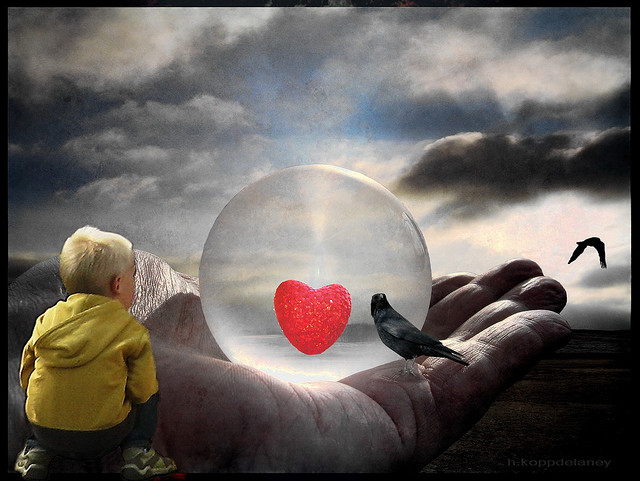
Then he roughed my nappy head up and told me to beat it.
THINGS ARE NEVER AS THEY SEEM
Later, long after he passed, I began to understand what he meant. It’s never a mechanical rote practice or technical application of whatever profession or interest you have. It’s a pure passion imbued in the heart that leads to prestidigitation. A heat in your heart that creates soul-moving magic. The Third Hand is not possible without it.
I also realized this; Nothing is ever as it seems. Grandpa was the most unlikely-looking piano player in the universe, more suited to play the Grandpa in John Mellankamp’s “Rain on the Scarecrow, Blood on the Plow.”
BUT THIS IS AS IT SEEMS
Years later I started playing the piano. Couldn’t do it the easy way and get a teacher – had to do it the stupid way and teach myself. Learned how to read music (barely) and play. After I had gotten cocky enough (which wasn’t long), I went to an old friend, Willie Marshall, who owned a music store, and bought the collected works of Scott Joplin in sheet music from him. Willie assured me the sheet music was an accurate, note-for-note transcription. Better yet, there was a music CD with all the songs on it so I could play along to teach myself.
AN EXQUISITE MOMENT
It was an exquisite moment. Moving. A spiritual-like high that lasted until…
SPECIAL THEORY OF “NEVER GOING TO BE ABLE TO PLAY IT EVER” RELATIVITY
… I got home. I opened the book to the sheet music of the Maple Leaf Rag.
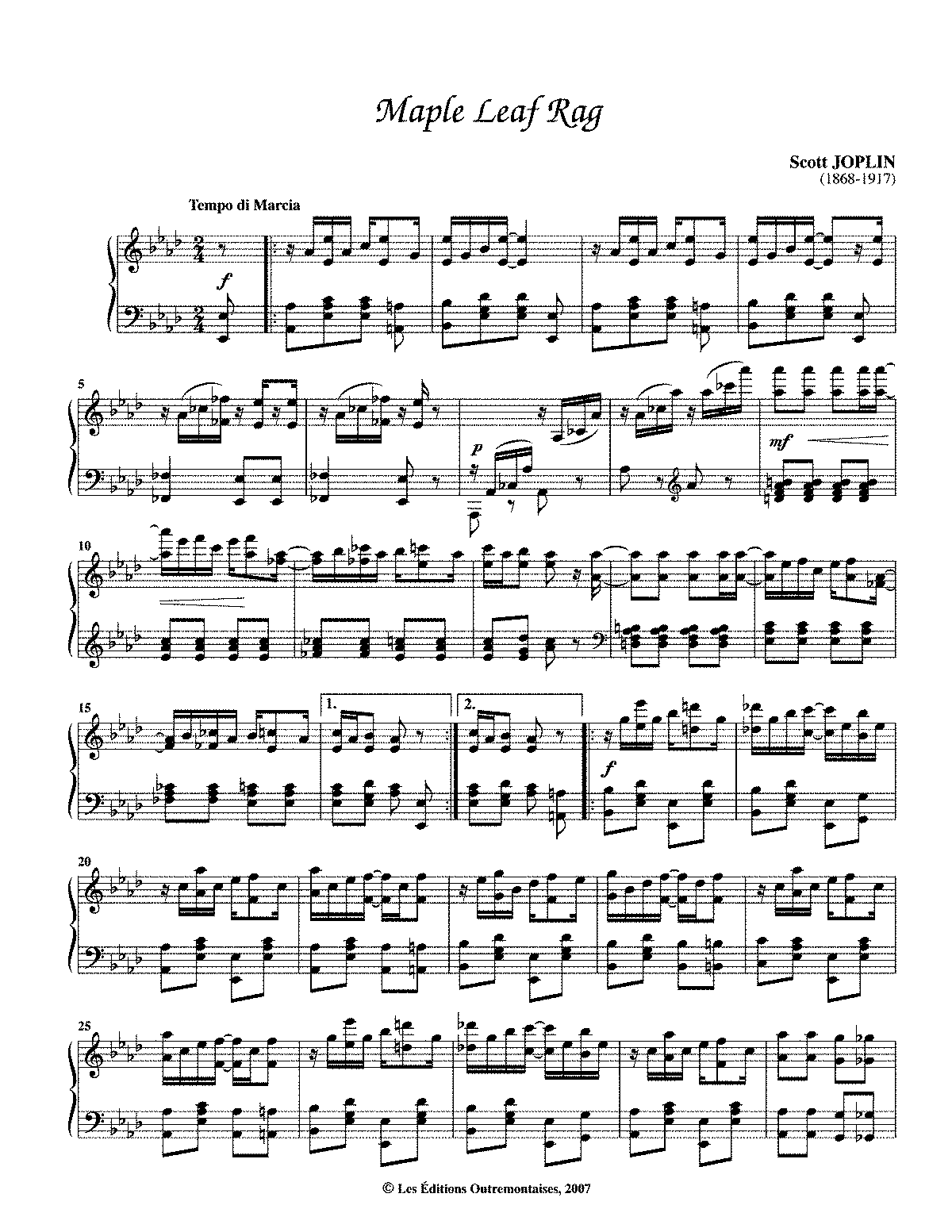
It looked like Einstein’s Special Theory of Relativity. Not the General Theory – The Special Theory – unfortunately, I know the difference. I spent the next six months practicing the damn song and just couldn’t get it right. I couldn’t get my rendition to match the music on the CD. Occasionally I’d get close, get a whiff of magic, of pixie dust – but it was like someone had physically dubbed the Third Hand into the music.
Finally, I got frustrated and went back to Willie for advice. Took the book and music CD with me. Willie was a long-time rock-n-roller, super-talented, could play any instrument (I hated the guy) and was a master sight-reader. My music reading was more like Braille with a jackhammer.
“Willie, I’ve tried and tried to play this song and just can’t get it. I can’t get the sheet music to sound like the CD. It’s like somebody dubbed a third hand onto the music”
Willie looked at the sheet music, then the back of the CD, and then looked at me.
“I said the sheet music was a note-for-note transcription. It is. You never got close to making it sound like the CD version?”
“No. A couple times I almost did. Thought I nailed it. Actually sounded like three hands were playing. But really, only for a couple brief moments. I couldn’t do it consistently. It really does sound like there are three hands playing.”
THINGS REALLY ARE NEVER AS THEY SEEM
Willie took a deep breath and let out what might be called a belly-wrenching guffaw.
“There are three hands you big dummie! They dubbed a third hand in on the CD. Didn’t you read the liner notes? I never said the CD was note-for note with the sheet music.
STUPID IS AS TWO HANDS DOES

Nothing makes you feel more stupid than realizing you’ve been trying to play 3-hand music with 2-hands … for six months. It did make me feel a little better about my progress. But stupider. So, taking the high road I said,
“Why would they do that? Don’t you think that should have bolded the text so I would’ve known three hands were playing?”
“Bold what you didn’t read so you wouldn’t read it?”
Willie had a point. Another reason I hated the guy. Besides being a musical savant, he was annoyingly logical.
“Why would they dub a third hand in,” I said, trying to extract my stupidity gracefully with a musical theory inquiry.
THEY CALLED HIM THE…
“They were trying to recreate a sound from some old-timers tale about when they used to have traveling piano shows around the country. There was a legend that some long- forgotten piano player could play that song better than Scott Joplin himself. He’d get on stage and it would always take two piano players to match him. Said he played Joplin better than Joplin himself. They called the guy The Third Hand.
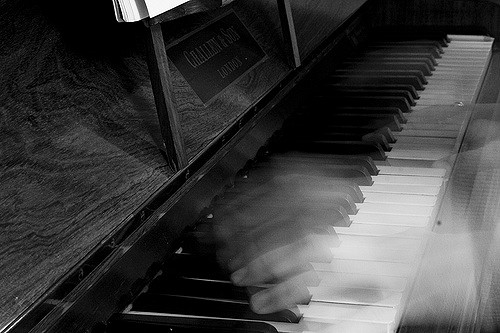
Just a myth though.
A legend.”
Things really are never as they seem.
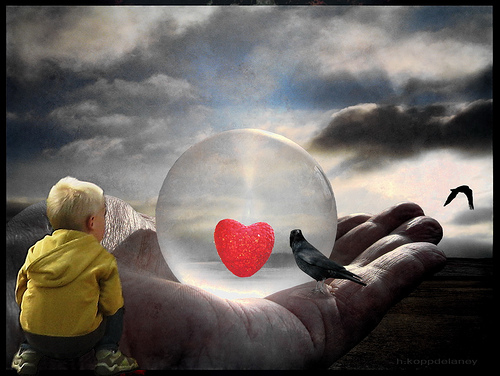
“We must not allow the clock and the calendar to blind us to the fact that each moment of life is a miracle and mystery.” – H.G. Wells

photo courtesy of H. Kopp Delaney
Better. Faster. Cheaper. (BFC)
BFC – the mantra of successful business. As well it should be, and needs to be. But sometimes in pursuit of BFC, whether in the life of business or the business of life, you overlook, take for granted, or are blinded to wondrous achievements happening everywhere around you – achievements that not long ago would have been called miracles, or magic.
Suddenly, out of the blue
You come face-to-face with an unexpected life crisis. It happens to everyone, you (yes I’m talking to you, the reader) are not immune.
No one is.
Not now.
Not ever.
And, when it comes to your health, or a loved one’s health, you’re smacked down hard. But, then something happens. A special moment in time. Something that force-face-feeds you to look … to see, not through life-hazed, better, faster, cheaper eyes … but really see.
Something wondrous.
Something magical.
Miracles and miracle-makers in your midst.
Queasy easy? Stop here.
This is a true story. It’s graphic. Reality is rough. Truth is tough. So if you get queasy easy, stop here.
This story describes a complex melding of, and interplay between, some spectacular people, processes and technologies that combine to create a real-life, dynamic human organism. An organism that breathes, reacts, corrects, heals and cures. And, it’s powered by the
Heartbeats of Healing

Photo courtesy of H. Kopp Delaney
At the end of this story you’re going to meet some real-life heroes, day-by-day miracle-makers.
Cincinnati Children’s Hospital – 6 a.m. – A Friday in March
An 11-year-old little girl arrives with her parents. She looks scared.
She is.
She’s here for major spinal surgery. Two operations. Not one … two.
It’s been a long, but quick, road to this point – the pre-op room in Cincinnati’s Children’s Hospital. She’d been diagnosed with severe scoliosis, a curvature of the spine, eight months ago. The disease had progressed rapidly. It had been hoped that corrective action could be put off until she was in her early teens.
But it couldn’t.
The little girl doesn’t want to be here. Anywhere but here. You can see it in the way her brilliant green eyes dart back and forth. Before she left her home in the morning, she’d locked herself in the room and wouldn’t come out. Then, after cajoling her out of the room, she bolted outside into the darkness of the morning. Tried to run away. Her father chased her down. Brought her back to the car screaming.
She sobbed the entire trip to the hospital.
What is Scoliosis?
This thing “scoliosis” was a monster to her. Why was it chasing her? Why had it now caught her?
Scoliosis is the medical term for curvature of the spine. Spinal deformity is due to a myriad of causes. The etiology (cause or origin) of the most common type of spinal deformity, adolescent idiopathic scoliosis, is unknown, but it’s strongly familial.
Translated … it tends to run in the family.
It affects anywhere from two to five percent of the population, but only 0.6% of people ever need treatment. Females are eight times more likely than males to have the severe type of scoliosis that requires treatment.
Detection
Scoliosis is detected by screenings and x-rays. X-rays are read to determine the degree of curvature in the spine.
The Curve
 Typically, angles of curvature (curves) of:
- 0-10% are within normal ranges
- 10-30% require continual observation
- 31-45% require treatment and bracing
- 45% end up usually requiring surgery
- 50% and up is considered severe.
This little girl’s angle of curvature was 60 degrees when discovered, and progressed rapidly to over 75 degrees. For each inch she grew upwards in height, another inch was redirected sideways, causing compression on her trunk.
A noticeable hump had begun protruding from her back.
Some of the effects of severe scoliosis can include:
- Progressive back pain,
- Cardiac and pulmonary compromise,
- Deformity, and
- Dissatisfaction with appearance.
She was here because there were really no good options for her besides surgery. It was the only path of hope to a vibrant, normal, thriving future.
Pre-op
The little girl was ushered into pre-op. She sat on a chair looking incredibly small and vulnerable as a bevy of nurses, doctors, and anesthesiologists spoke with and questioned her. Facts were checked, double-checked and then triple-checked. Many times the same question would be asked.
That’s good.
There was no room for error.
None.
Every possible complication and medical history was explored then re-explored. It had been that way for the previous several months.
The last several weeks had gotten harder and harder on her, as the operation neared. She’d made weekly trips to either donate her own blood for the operation, see her doctors or nurses, and take lung, heart or other tests. But where had all this begun?
Her journey
It turns out that her journey had followed a very well-defined, step-by-step process, hitting points that culminated in her current situation. The steps are:
- Screening and early detection
- Observation of changes in deformity over time with informed judgment regarding prognosis and operative/non-operative interventions
- Surgical planning and operating
Throughout this process the family had a chance to become very comfortable with the hospital, staff and faculty of Cincinnati’s Children Hospital. They were friendly, polite, courteous, and more importantly, internationally recognized innovators in treating this disease.
It also helped to know that Cincinnati Children’s Hospital Medical Center had been named one of the 10 best pediatric hospitals in the United States, according to U.S. News & World Report’s Annual “America’s Best Hospitals.”
The pain scale
An anesthesiologist explains a pain scale of 0-10 to her. After the operation, she is to give them a number that describes what her pain feels like. 0=none, 10=worst imaginable. The anesthesiologist then asks her what parent she’d like to accompany her to the operating room to watch her “go to sleep.”
“Neither, I am 11 years old.”
Yes.
She was an 11-year-old after all. Tough and stubborn (in public anyway). Qualities that will serve her well in the next year. But especially in the next two months.
She’s wheeled off to surgery by her own little 11-year-old, stubborn self. She leaves, looking up at the ceiling with a blank vacant stare – brilliant green eyes. You have to wonder what an 11-year-old girl thinks at a moment like that.
The waiting room – 7:30 a.m.
The parents and family sit in the waiting room at the hospital. It’s packed. Loud. perpetual motion. But the chairs are comfortable … sorta.
10:00 a.m. The phone rings at the front desk. A grandmotherly receptionist motions the parents over.
It’s part of the process. To let family members know how things are going. Seems simple doesn’t it? It is. But it’s incredibly effective.
Simple things are good.
The first phase of the two-part operation is progressing smoothly. The objective is to enter through her right rib cage with video-assisted, image-guided surgery (incisional endoscopy).
Innovative technique
This method goes in through the rib cage using three or four small incisions to reach the front of the spine.
Looks something like this

Once inside the chest, the spine is clearly visible and “soft” tissues can be cleaned off exposing the spine. Among other things that I am totally unqualified to write about, I understood, nonetheless, that the connective tissues were released to the spine so that it could be manipulated and made flexible for phase two of the operation which was to take place 7 to10 days later.
Sound scary?
Probably not.
Unless it was you or one of your family members. Then I suspect it might be.
The minimally invasive approach
This is called a “minimally invasive” approach. Minimally invasive surgery utilizes small skin incisions, minimizes the damaging effects of large muscle retraction, and attempts to leave the body as naturally intact as it was prior to surgery.
Translated … feels better, heals better, looks better
Or for you business folks out there, better, faster, cheaper.
The goal is to achieve:
- rapid recovery,
- lessen post-operative pain, and
- leave cosmetically satisfying incisional scars.
Translated … feels better, heals better, looks better
If enough flexibility of the spine can’t be achieved this way, they’ll have to resort to the old-fashioned body-opening. They’d peel her back like a can of tuna from the front to the back of her rib cage, afterwards and forever leaving a big scar.
Time’s Arrow
 Moves On
12:00 p.m. – nothing.
1:00 p.m. – nothing.
Overheard conversations. Salutes. Testimonials.
The waiting room begins to empty. Few people are left. The people that remain, begin to bond, open up, and explain why they’re there. And their stories, bar none, are a salute and a testimonial to the skill and reputation of Cincinnati’s Children’s Hospital. The majority of people left, on this Friday in March 2004, are all from out of state.
Not from Cincinnati or Ohio. They’ve flown in from all over the United States to have their children cared for, healed.
Hope of healing
Distance is not a deterrent to the hope of healing.
2:00 p.m. – nothing.
Worry sets in.
3:00 p.m. – nothing.
No matter how comfortable the chairs are, sitting in a waiting room for that long, seeds discomfort – mental and physical. Pacing starts.
3:30 p.m. – finally. The call they’ve been waiting for. Finishing up phase one. All went well.
4:30 p.m. – Family gets to see their young daughter for the first time in the
Intensive Care Unit (ICU)
Did I forget to mention that the operation entailed the little girl being in traction for 10 or more days?
If you ever get a chance to see someone in traction …
Don’t.
If you ever get a chance to see a little child, a little girl, in traction …
Run.
The family’s first sight of their daughter is heart-rending. A great vacuum sucked all the air out of the room. Like being shot in the stomach by a Hellfire Missile.
“The operation went great,” explains the doctor.
But the family, particularly the father, could only stare at the little girl.
What is traction?
Well, there’s the medical definition, then there’s mine. I’ll give you both.
The medical definition of traction
Spinal traction is based on the application of a longitudinal force to the axis of the spinal column. Parts of the spinal column are “pulled” in opposite directions in order to stabilize or change the position of damaged aspects of the spine. The force is usually applied to the skull through a series of weights or a fixation device and requires that the patient is either kept in bed or placed in a halo vest.
Certainly is distractive
Spinal traction relies on the application of a distractive (“upward”) force being applied to the skull while the rest of the body is held in place. The use of a device that is firmly attached to the skull is required for the successful application of this force – a device which is basically a ring that is attached to the head through a series of pins. The traction force is initially applied through both of these devices by fixing the patient’s torso in bed while a series of weights are gradually added.
Got that?
My definition
Think medieval rack.

The girl’s legs have screws about the size of magic markers running completely through both her legs directly above the knee. Darkened blood and tissue-matter are clearly visible.
Okay … one more time.
Buzzzzzzzzzzzzzzzzzzzzzzzzzzzzzzzz.
Grind.
Buzzzzzzzzzzzzzzzzzzzzzzzzzzzzzzzz.
Drilled completely through her legs, above her knees.
What’s that look like?
Looks something like this

The screws stick out of both sides of her legs. Rope is attached to the screws, which wind down to a pulley where weights hang and pull her body downward.
Next?
A horseshoe-shaped metal ring surrounds her head. At the bottom of this ring?
Screws. Or “pins” as they may be called. Screws to me.
Buzzzzzzzzzzzzzzzzzzzzzzzzzzzzzzzz.
Grind.
Buzzzzzzzzzzzzzzzzzzzzzzzzzzzzzzzz.
Pins drilled and attached to her skull.
At the top of the horseshoe-shaped ring, rope runs up to a pulley where weights hang down. Her head is pulled in the opposite direction from her legs.
Her body is being pulled apart.
Stretched.
Pulled.
What’s that look like?
Sorta like this
 Why?
Why?
It’s necessary for phase two of the operation. To loosen and straighten the spine gradually, so that the risks (paralysis among others) are diminished.
Traction will be in place for the next 10 days, with the weights increasing daily, until the little girl has 30 pounds pulling her head upwards, and 30 pounds pulling down from her knees.
She’s immobilized with the exception of some movement of her arms.
So. There you have it. My definition and an official medical definition. Either way, do you get the picture? It really is simple. Think medieval rack.
Back to first sight
The little girl is heavily drugged, has IVs inserted in her arms to deliver medicine and food, a catheter to take care of bodily functions, an oxygen mask on to help her breathe, two tubes sticking out of her nose, and a couple of other hoses inserted in various parts of her previously perfect body for trauma drainage purposes.
Very little on her innocent young body has not been penetrated or tapped or wrapped with something.
Technological wonders
The technological marvels wrought by industry research, development, application and availability to perform healing triumphs are, unless you actually see it, almost ineffable.
Tiny thingy on a tiny pinkie
The little girl is hooked up to multiple machines, technological wonders, that monitor all of her important life functions, everything. And a lot of the information comes from a little attached finger wrap that emits a glowing red light.
The red light doesn’t get hot. Or even warm. Not at all. How cool is that?
But through this little red-light finger attachment, her body is monitored and melded with a machine that, when warranted (which is about every 10-15 minutes in this young girl’s case), sets off loud alarms that can either notify of heart stoppage, low oxygen, blood-pressure anomalies or other functions vital to her survival.
Another time. Another place. Magic. Big magic.
The little girl is still bloody in many places over her body. Dried. Dark. Blood. But, she is well sedated and doesn’t seem to notice too much yet. She floats in and out of consciousness.
Pain scale
This is where the pain scale comes in. The nurse asks her what number she feels (0-10), and they respond accordingly, plus she has her own little push-button device that is quite impressive. Whenever she feels pain, she pushes it and self-administers morphine. She can’t overdose herself because the machine is intelligent – programmed with intelligent software that, based upon her weight, age, and various other factors, will only administer a specific dose every eight minutes if needed.
The young girl’s teenage brothers come to see her in the ICU.
After they recover from the initial sight, they look like they have been run over by a truck. The only part visually recognizable to them is her little face covered by an oxygen mask, but even that is swollen.
Bells and tubes
Alert bells constantly go off, oxygen too low, heartbeat too low, pain too high, IVs clogged, IVs empty.
Drainage tubes fill up and need to be emptied, get blocked and cause poisons to seep back into the little girl’s body.
It’s 24-hour, minute-by-minute care. Observations, corrections, logging information, calling doctors … perpetual motion.
Enter the Heartbeat (s)
The technology is advanced, it’s spectacular, best in the world. But without the human touch, the caring touch, the empathetic touch, the healing touch, it’s irrelevant.
The nurses are great. Caring, courteous, attentive, empathetic, responsive. Seems as if they have turbojet shoes on. The slightest alarm and they race in.
A near-disaster
11:00 p.m. The drainage tube which runs up from her stomach and out of her nose, pulling poisons and waste from her stomach gets blocked and backs up. The little girl begins to vomit.
She’s laying on her back.
Immobilized.
The little girl can’t move her head. She can’t stand. She can’t roll her head to the side because the screws stick too far out of her head.
She is suffocating in her vomit.
The nurse rushes in and with the little girl’s mother’s help, cleans and suctions out the vomit – she begins to breathe again.
The tube got blocked. No mistake. Just something that can happen. A lot of poison, waste and drainage can muck up a tube.
Try this at home … not
The tube needs to be replaced. It’s pulled up from the depths of her stomach, with the black gooey poison and waste splattering everywhere. Up and out through her nose accompanied by a heavily drugged pained yelp.
Then … a new one. A bigger tube is inserted and pushed back through her nose into her stomach.
Garden hose up your nose
A very painful process. Like shoving a garden hose up your nose and down into your stomach. The gagging reflex kicks in. The little girl now has two bigger tubes running down her throat. They will stay there for the next 12 days.
After day one, the little girl has to be turned. Turned you say? That doesn’t sound bad.
Well, she is strapped to a special bed called a “Stryker.” It’s designed so it can be flipped upside down with the patient secured by straps and a large oval, metal bar.
The Stryker

Four nurses come in, take special straps, and secure them. They get the top part of the stretcher and put it on top of the little girl.
They then get a large metal bar, which has to be forced down, vise-like, until it clamps on the other side.
When it’s secured, and the little girl is squashed inside, moaning (or screaming in pain), the nurses rotate the bed upside down. This takes a lot of physical effort and concentrated attention because all the tubes and IVs have to be carefully held and flipped at the same time so they don’t kink.
Oh … did I forget to mention
That the traction stays in place and is flipped at the same time?
Then, when the little girl is upside down, they release the clamps and the top half of the bar is removed. She’s now facing down. This takes about five to ten minutes, and will be done at least once every shift for the next 12 days.
CINCINNATI CHILDREN’S HOSPITAL – BUILDING A-6N

The Home of the Heartbeats of Healing
You give but little when you give of your possessions.
It is when you give of yourself that you truly give.
– Kahil Gibran
On day three after the operation, she is transferred from the ICU to a special unit at Children’s Hospital, A-6N.
During the next two weeks, the nurses care for her like she was their own child.
That’s right.
They care for her with the same attention and love that a mom, dad, or family member would.
Could you ask for any more than that?
Battling, struggling, healing, hoping
One has to wonder how the nurses that see this kind of trauma and pain on a daily basis, cope with it. They’re in the trenches. Battling. Struggling. Healing. Hoping.
You just have to be a special kind of person.
Very special.
You just have to be a … “ Heartbeat of Healing.”
A-6N Heartbeats never sleep
For the next seven days, it’s a series of beeps, alerts, moans and screams.
Twenty-four hours a day for seven straight days.
Words no parent ever wants to hear:
“Daddy I can’t breathe.”
“Mommy I’m going to throw up.”
She was strapped down. Pinned by weights. Quietly pulling and stretching, with the connective muscle and tissues disconnected from around her spine.
She can’t stand the thought of going to the bathroom being immobilized the way she is – an insufferable indignity for an 11-year-old girl. Everyone had to leave the room … except the nurse.
More words a parent never wants to hear:
“Let me up! I can’t move!”
“I can’t see. I can’t see!”
She’s in constant pain and heavily medicated. Morphine. Dilaudid. Roxicet. Valium … and many, many more. Wonderful pain-management tools. If it were possible, you’d wish there was a way to induce a healing coma so the innocent victims could sleep through these kinds of operations. But some of the medications have side effects on the little girl. Hallucinations for one.
Dreaming when you’re awake … no fun
“I hate this! I can’t stop dreaming when I’m awake. Make it quit.”
This goes on, and on, and on. And the nurses were there.
All the time.
Every time.
Can you say any more than that?
Yes … some of the nurses stopped by on their off hours. Get that? Their off hours.
One nurse brought in her own personal shampoo for the little girl, who has a flowing mane of locks as thick as the earth’s mantle. They shampooed her, then helped braid her hair.
On their own time.
“A child’s life is like a piece of paper on which every passerby leaves a mark.”
– Chinese Proverb
There was never a 15 to 20-minute respite when something wasn’t happening. Noises. Alarms. Cleaning. Doctors. Nurses.
And each day more weights were added in traction. To pull her head north, her torso south.
One amazing thing … so extra-step
I noticed immediately. I think because it seemed so unusual … so “extra-step.” The nurses not only empathized and treated the little girl like she was their own child, but were spectacular with the family – the father, mother, brothers, and visiting relatives, anyone who was present in the room with their little 11-year-old angel. The nurses brought food, drinks, videos, blankets, pillows, towels … you name it for whatever family member was there.
“What dazzles, for the moment spends its spirit;
What’s genuine, shall posterity inherit.”
– Goethe
They took a genuine interest.
Genuine.
That’s hard to find this day isn’t it?
SECOND OPERATION – PHASE 2
One week and a lifetime later, the little girl was back on the operating table again.
She went in for the second operation at 7:30 a.m.
11:30 a.m.: The waiting room phone rings for the parents. All the blood the little girl and her family donated over the previous six weeks for the operation, enough to normally do the operation … is already gone. They ask for the parents’ “okay” to go to the blood bank.
Ever seen a squashed possum in the middle of the road? That eerie, dead, glazed eyeball look? If not, had you been in the waiting room with the little girl’s parents, you would have.
12:00 p.m. … 1:00 p.m. … 2:00 p.m. … 3:00 p.m. … nothing.
Silence can be scary
RING –
Complications. Nothing major. Should be done in 1-2 hours.
4:00 p.m.
5:00 p.m.
RING – Another hour or so.
7:00 p.m. – Finished.
ICU … AGAIN – 7:30 p.m.
Back where she started. Back in ICU again. The little girl had been on her stomach for a long time, opened up from the top of her butt almost to the tip of her spine.
What’s that look like? Well … sorta like this.

Stainless steel rods were implanted along the sides of the spine connected by pedicles (hooks and nuts). It looked like a high-tech, internal latticework.
What’s that look like?
Sorta like this … a before and after The little girl is once again traumatized. Her eyes are swollen shut and she looks like she just got out of a world-heavyweight boxing match.
But the traction weights have been reduced down to 10 lbs. and should be off in 2-3 days.
That’s good. Really good. Once again, she is in and out of a heavily drugged consciousness.
THEN
The next day, 7 a.m.. The swelling has noticeably reduced. A neurologist comes in.
More words no parent ever wants to hear
The neurologist quickly notices something wrong – he asks her to follow his fingers. Only her right eye moves and follows. The other one is frozen in the middle. Stuck. Paralyzed? It causes her to look cross-eyed.
Here’s what the neurologist said:
“Is there a history of stroke in the family?”
Here’s what the family heard:
“Trouble. She might have had a stroke.”
The team of doctors that came in shortly was like a world-class, high-tech SWAT team attacking a holed-up terrorist. Neurologists, Ophthalmologists, Orthopedic Surgeons, and on and on … trying to figure out what was wrong. They poured over her medical records for her entire stay to date, line-by-line, looking for anomalies.
No MRI possible
An MRI (magnetic resonance imaging) was needed on her brain. The neurologist wanted it done immediately.
But … it couldn’t be done immediately.
Why?
Traction. The metal pins were still screwed into her head and the horseshoe-shaped metal bar. If they took them off prematurely, it could cause paralysis.
A dark night of the soul for any parent
During the operation, the little girl had to have blood transfusions. One unpleasantly little-known side effect of a blood transfusion.
Internal itching.
Total body itching. But that’s not too bad.
“Daddy I itch! On the inside. Something is crawling inside me.”
It feels like it comes from the inside of your body. Imagine having 1,000 termites inside your body.
Once again, the nurses ride in with their heartbeats throbbing. They caress her little face, hands, legs, and administer anti-itch medicine.
At 1:00 a.m. that night the father thanks them profusely. He recalls the night before her operation to the nurses. She forced him to go see a Johnny Depp movie called “Secret Window” with her.
Just her and her Dad. Dad and growing daughter.
Cotton candy; oily, buttery popcorn; cokes and snowcaps.
Normal.
Just normal.
You don’t truly appreciate the “normal” moments until abnormal knocks you in the head.
What happened?
The doctors had no explanation for her condition. They thought maybe because blood loss was substantial and the operation was long, the brain may have shut down blood flow and oxygen to that side, or to the nerve that controls the eyes. (The brain does that when it thinks the body is dying, trying to protect vital organs.)
Prognosis? Maybe her eyesight would come back in 4-6 months.
Maybe it wouldn’t.
Ever. Just didn’t know.
Even with the greatest technologies and knowledge in the medical world, this was an inexplicable occurrence.
Healing and the internet
The little girl’s father was having a difficult time with this. He went outside into the dreary, drizzly night for a private moment. When it’s late, dark, and you walk out into a dreary raining night, thoughts can haunt you, guilt can overwhelm. He recalls forcing her into the car to drive her to the operation, after she had made an attempt to run away into the early morning darkness.
Now this. Could it have been done differently? Later? Another time? Another day?
He went back upstairs to A-6N. When the little girl slept, he would check his e-mail.
A strange thing happened.
A lot of people had put this little girl on their internet prayer groups. The father began receiving notes, e-mails, cards from people and churches all over the world saying they were praying for her.
The networking effect of the internet was pretty amazing. It took him totally off-guard. Massive amounts of e-mail, mail, gift baskets, etc., began pouring in.
Doctors don’t care
On the fourth day after the operation, her eye began to move again.
Why?
Who knows … was there a correlation between the internet prayer group campaign and her turnaround?
Who knows.
I’ve spoken with some doctors and researched this phenomenon. There is quite authoritative and quantitative research that shows prayer actually works in the healing process.
Why?
No one knows really.
But the doctors I spoke to didn’t care.
It worked. And that’s all that mattered to them. It worked. Anything that helped further the healing process was fine by them.
Finally
Traction was removed. A simple thing. Unscrew the pins in her skull. Then to the leg. Know how those screws come out?
I won’t tell you. But

You get the picture?
Every Day, in Every Way, Better and Better

Each day her eye functioning got better and better. It slowly returned to normal six weeks later.
No reason. Just came back on its own.
“Pretty much all the honest truth-telling there is in the world is done by children.”
– Oliver Wendell Holmes
The little girl rebounded quickly. She was in the wheelchair for the first couple of days, then she refused to ride in it anymore. She was quickly moved to a “walker” which she shortly thereafter determined to be “un-cool.”
She just wanted to get out of the hospital so bad. To her she had been there a lifetime and was seriously worried that
“My Cat Won’t Even Remember Me!”

She’s in a brace now for the next six months.
But, in a testimonial to the world-class skill and expertise of the doctors and nurses of Cincinnati Children’s Hospital … they originally thought that they could only correct her spinal deformity 50% … which still would have left a big curve. The X-rays were incredible. They had nearly straightened it perfectly. Like a flagpole. But, a costly side effect? The little girl grew several inches in height … in one single day!
“I’ll need a new wardrobe Dad.”
Now she is learning to walk again (looks like the Tin Man on the “Wizard of Oz” ).

But in my opinion, she is a little miracle girl. A miracle brought about by the doctors and nurses – the Heartbeats of Healing – of Cincinnati Children’s Hospital.
Oh … before I introduce you to them, I almost forgot … the little girl’s name?
It’s Stephie.

We, amazingly enough, share the same last name.
And, there’s a reason for that. She’s my daughter.
Instauratio Magna – The Great Renewal
What to draw from this? This story? These Heartbeats of Healing?
All kinds of things I guess. But for me, personally, it was an overwhelming gratefulness. Or, as Roger Bacon once wrote “Instauratio Magna,” a great renewal.
A gratefulness for being alive in this day and age. Had this been many years ago, she’d probably be doomed to paralysis, deformity, pulmonary and neurologic compromise.
Gratefulness for a personal awakening to the magic and everyday miracle workers that are often overlooked by a better, faster, cheaper pursuit mentality.
Grateful for a second chance at a normal life for the little girl.
Grateful for the nurses who gave her sustenance, and

and healing (and painkillers, man the painkillers, morphine, vicodin, roxcet, dilaudin, oxycotin and a gazillion others) but mostly for treating her like she was their own daughter. There is no word that expresses the thanks for the comfort that gave.
Grateful for the doctors, technology, and researchers that paved the way for today’s doctors.
“Bear in mind that the wonderful things you learn in school are the works of many generations. All this is put in your hands as your inheritance in order that you may receive it, honor it, add to it and one day faithfully hand it on to your children.” -Albert Einstein
Grateful for the doctors who pioneer these life-enabling surgeries and perform them every day – even at the risk of being sued out of business. One mistake equals paralysis and a life gone awry.
Grateful for all the people I have never met, nor probably will, that took time out of their busy lives to say a prayer for a little girl they had never met, nor probably will.
“You must be the change you wish to see in the world.” – Mahatma Ghandi
Grateful yes. That’s the word. But also changed. “Instauratio Magna.”
And Now … Introducing Cincinnati Children’s Hospital Medical Center logo America’s best children’s hospitals by US News.
HEARTBEATS OF HEALING
Healers. Miracle–workers. Professional experts that daily perform life-saving and enabling surgeries. Unless you see them in action, it’s hard to believe.
If you are ever in Cincinnati and want to meet some world-class heroes – doctors, nurses and administrators – or need their specialized healing services …
Here they are.

TO ALL THE NURSES OF CINCINNATI CHILDREN’S HOSPITAL A6-N!
So many wonderful nurses I’m afraid if I named all 70 of them I would miss one. Each and every one was courteous, caring, wonderfully responsive and empathetic. Special thanks to Janelle for bringing in her own shampoo, and Nita for laughing so much, and Kelly for being so patient, loving, caring and responsive even when she had 2,000 things going wrong at the same time. I suspect Kelly could have been an Olympic sprinter based upon what I saw. And, Lauren, for understanding a dazed and confused look for what it was. An Ophthalmologist described in complex detail the nerves that may have been damaged to cause Stephie’s eye to lock up. Lauren went back out and asked the doctor to come back and translate what she said into English for me. Explain in simple laymen’s terms. And, a heartfelt
A Super-Duper-Califragilisticexpialidocious Thanks
to each and every A6-N nurse. Each one, bar none, was spectacular. A real-life MASH teamwork and high-tech professionalism that’s almost too amazing for words.
And also to …
 Peggy W. Beavin, RN, CNS
The Head Nurse. Peggy always smiled. Even when she probably wanted to smack me upside the head. So polite. So courteous. So strong when she needed to be.
Darlene A. Brooks, RN, BS
A real sweetie. Children flock to her. I know Stephie did. (No picture available. But I would like to ask her what the BS stands for.)
And NURSE CINDY!
Darlene and Cindy were Stephie’s special spinal nurses. Always answered our concerns and calls (still do). They made the unintelligible understandable. Allayed the fears. Comforted the heart. Could you ask for any more?
The Doctors:
 Junichi Tamai, MD
Dr. Junici Tamai, Assistant Professor Clinical Affiliated of Pediatric Orthopaedics, University of Cincinnati Medical and the lead surgeon on Stephie. He was tireless in his efforts. Truly spectacular in his work. The results of the X-rays are unbelievable. Can you imagine what it is like to cut open a child from neck to butt, and work on her spine for hours on end, knowing the slightest mistake could lead to paralysis?
Needs work on his sense of humor though. When Stephie’s brace was taken off the first time to be checked, she had an unusual anomaly. If you touched her on the lower back or got within an inch of it, she started giggling, jumping, or laughing. When I suggested he may have “wired something wrong, perhaps the ‘giggle reflextor-rectus nerve’ in Stephie’s back,” it took him a little while to see the humor in it.
That’s okay. He can wire the giggle reflextor-rectus nerve wrong anytime he wants. Just keep on healing, Dr. Tamai. But, if you have a spare guide to “humor and understanding the giggle reflextor-rectus nerve response,” feel free to send it to him. E-mail: [email protected]

Alvin H. Crawford, MD, FACS
Dr. Alvin Crawford, world-renowned Professor of Pediatric Orthopaedic Surgery, University of Cincinnati Medical Center. Supervised and assisted Dr. Tamai. Dr. Crawford, is one of the nation’s foremost authorities on video-assisted thoracoscopic surgery and neurofibromatosis, and is the director of pediatric orthopaedics at Cincinnati Children’s Hospital Medical Center. E-mail: [email protected]

Eric J. Wall, MD
Dr. Eric Wall, Director of Outpatient Services, assisted and worked with Dr. Tamai during the operation(s). Warm, friendly, concise, kids love him. E-mail: [email protected]
ALMOST THE END
This article was originally written in 2004. It’s being updated now because of the remarkable progress Stephanie made. She was in a body cast for 6 months. Her prognosis for ever playing sports again was poor – too dangerous. But, she kept working at it, her body kept healing, and in her freshman year she made the high school soccer team.
It’s also being updated because Stephanie doesn’t remember much of what happened. And that’s good. But this article will remain here – in this ethereal, eternal digital world – if she ever wants to know what really happened.
And who to really thank.



 ###
###


Recent Comments
Lessons Learned from Hollywood STORY Guru Robert McKee