David’s writing is crisp, clean, easy to read and always full of helpful information and unique ways to authentically connect with people—and grow your business. That’s hard to pull off.
WRONG
I’m usually 100% supportive of David’s ideas and insights. Not this time. I think he and Brian got it totally wrong on the name and naming of the “Grateful Dead.”
RESEARCH
They must not have done their research. Had they done in-depth historical musical research, they would have uncovered where the Grateful Dead name really came from.
THE SECRET
As a business courtesy (back-stabbing) to David and Brian, it will be revealed here for the first time. That’s right. The real secret behind the naming of The Grateful Dead. Maybe David and Brian can correct their story in the second printing of the book to give credit where credit is due.
ALL FAIRNESS ASIDE
But, in all fairness, I’ll let them make their case first. Then I’ll expose their inaccuracies. Rip them to shreds. Professionally of course. But be prepared – some graphic pictures are coming your way. It may not be suitable for all readers. Make sure any kids under 50 are not in the room when you read this.
THEIR CASE …
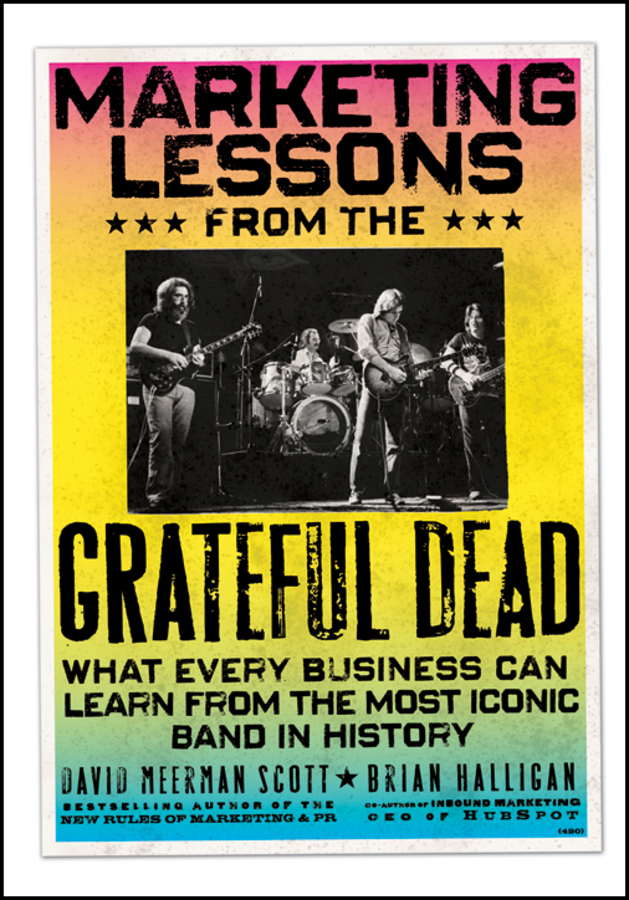
A Marketing Lesson from the Grateful Dead – Choose Memorable Brand Names
By David Meerman Scott and Brian Halligan
The Grateful Dead.
If you stop to think about it, the name is sorta weird. Even a little scary.
But boy is it memorable.
Originally calling themselves The Warlocks when they formed in 1964, members of the band realized they needed to come up with a new name a year later when they found out that there was another band by the same name that had recorded a single. The guys debated names, suggesting ideas such as “Mythical Ethical Icicle Tricycle” (Garcia) and “His Own Sweet Advocates” (Weir). When they were unable to find a name they agreed on, they gathered at Phil Lesh’s house around a copy of Bartlett’s Quotations, read out a thousand possible names, but couldn’t agree on anything. Then Jerry Garcia opened a copy of Funk and Wagnall’s New Practical Standard Dictionary (1956 edition) and randomly pointed to a page. There, staring back at him, was GRATEFUL DEAD. Several members immediately fell in love with the name and wanted to use it. Others were a bit wary. But all agreed it was memorable so they decided to use it.
Love it, hate it, or don’t understand it—the Grateful Dead is a name that you remember.
A name–like the Grateful Dead–is an asset to an organization choosing wisely. When you select an uncommon name (and one appropriate to your company image and target market) it’s unlikely that consumers will confuse your product with something similar. They will remember you. And in today’s world of online communications and of search engines, unique names for your company, products, and services allow you to own the search engine results for your brands.
Most companies don’t focus enough attention on choosing a memorable name or to the importance of Google, Bing, and other search engines when selecting those names. Typically people closest to the product development effort are the ones proposing the candidate names. This usually leads to overly technical names focused on what a product does (something like “MP3 Deluxe Pocket Player” rather than a memorable name that appeals to customers like “iPod”). At most companies, candidate names are vetted by the legal department for copyright and trademark issues that would disqualify use, but few bother to do a Google search on the potential new name. If your company’s website is not on the first page of the Google results with your product name, that should disqualify it as an option.
Naming is tough. But it is a very important element of marketing. Most organizations don’t spend enough time on this important activity.
Action: Here are some things to keep in mind and a few tricks you might try as you think of a name:
Avoid common names and names that are already used as a title of a popular movie or book. You will want to have a name that you can have the top listing for in the search engines.
Use search engines before finalizing a name. You don’t want to fall in love with a name that you cannot have the top search results for.
Find inspiration in unlikely places. Why not go to one of the online booksellers (such as Amazon.com, BN.com, or Borders.com in the US) and search on the name of the category of product you are trying to name. You’ll see a list of book titles and subtitles that may spark an idea.
Many people choose made up words as a name. This is great because you can own the search results. But try not to choose one that is too esoteric or difficult to pronounce if you go this route.
You might take two words that are very different and put them together as one word like SurveyMonkey, an intriguing company name.
Try an alternative spelling for a word. Google is a derivation of the word “googol,” a number that is ten to the power of one hundred (the numeral one followed by 100 zeros). Flickr is “flicker” with an “e” removed.
In her excellent book POP!, Sam Horn (http://www.samhorn.com) talks about what she calls “alphabetizing” common words to come up with a name. We like this technique. Take a common product you want to name, for example, Yogurt in a squeeze tube. Then go through every letter in the alphabet and substitute it for the “Y” in Yogurt and presto: “GoGurt” is born.
Take a common name and change it slightly to create a new word. For example social networking site FledgeWing is a derivation of the word “fledgling.”
END OF THEIR CASE – NOW IT’S MY TURN
That’s history as it’s recorded. The mythological muses smile on Jerry Garcia and the band and outPOPSthe name The Grateful Dead. It’s true that the name is memorable. But history is always written by the victors – biased biographies of the victorious.
THE REST OF THE STORY ( I’m sure Paul Harvey did this story once)
The real story was that there was this kick-butt band called “The Grateful Donk” that Jerry Garcia and the boys saw play at the Donkey Dewd Don’t You Drop Inn bar in Haight-Asbury in 1964. They were mesmerized – especially by the melodiously mellifluous kilt-wearing piano player and the talented Equus Africanus (Ass) lead guitarist.
David and Brian should have made full disclosure on this issue – they were there. Check out the picture. Really. It’s not “Where’s Waldo“; Brian and David are herein both graphically exposed.
EXPOSED
And being exposed was actually the downfall of this once-mighty band with so much potential. See the kilt-wearing piano player above? See how he’s rocking out doing his smoking best Jerry Lee Lewis ivory-licks? See the Grateful Donk fans in the front row? I mean the shocked, horrified and distressed-looking ones?
Well … getting to the bottom of it, the piano player, he uh, forgot something. Went kilt-kommando so to speak.
And you know that name?The Grateful Donk?
Love it, hate it, or don’t understand it—The Grateful Donk is a name that you remember
RUINED
Well it wasn’t. The band was ruined by the exposure.
The Grateful Donk tried to regroup. They killed the kilt guy, then added a female singer and guitarist named
BONNIE BRAY-IT
But the band never recovered from the kommando-kilt incident.
Jerry Garcia and the boys cribbed the name and stole the glory after the
band fled in utter disgrace and had to disband.
The kommando-kilt wearing piano player, (much like Boston’s Bill Buckner, after “The Curse of the Bambino” caused him to boot a ball in game six, and it cost the Boston the 1986 World Series,) took the disgrace like a manly man.
Forty years later he regrouped and now works in PR and Marketing for a software company.
And now you know … the rest of the story.
Epilogue:
The Equus Africanus (ass) lead guitarist later went on to great literary fame … his name? Donkey O’Tee, author of ;
The Grateful Donk stuff, though historically, solidly questionable, has nothing to do with David and Brian’s new book. Go check their book out for yourself.
And listen to the Grateful Donk Radio on the Blip.fm History Channel – Http://blip.fm/TheGratefulDonk no courtesy of investigative reporter @stevekayser on Twitter or Steve on Blip.fm at http://blip.fm/stevekayser
Featuring an interview with Lynne McTaggart, author of “The Intention Experiment.”
“This important book makes a good case that we are on the verge of another revolution in our understanding of the universe.” – Arthur C. Clarke
I Had Good Intentions
I fully intended to keep my 2012 New Year’s resolutions. I knew it would be hard. But I had good intentions. I had good intentions. Really.
However, even though I held out a long time – 6 days, 21 hours and 30 minutes short – of the first full week of January – I didn’t make it. I fell short. Badly. Some of it was simply from a sense of loss (also sometimes known as grief) that had weakened my resolve. Donkey O’Tee, my long-time co-writer and close friend, had left me to pursue his own career as an author (below).
Media Star
Donkey O’Tee had massive pre-sales. Five copies at least. The media loved him. He took a simple idea, complexified it to nearly an undecipherable obfuscation, eschewing logic and reason, and suddenly he was a media know-it-all star.
But, before Donkey O’Tee went on his book tour, he sensed my despair – my utter hopelessness. Donkey’s are like that. Sensitive. So, he sent two cousins of his to help me out while he was gone on tour. “Hollywood veterans” he assured me. Their names were Cal and Chichen (pronounced “chikken”) Itza (figure out which is which?) from Yucatan, a state in Mexico.
Cal, Steve and Chichen Itza
But they were a little too perky for me.
I slipped into a deep funk. I pondered why my good intentions always went awry. My hair grew out of control (which horrified my friends who were all going bald), and I seemed to shrink – grow shorter from the weight of the deep thought in which I was engrossed. Why did my “good intentions” always go so bad? Then … almost by accident (but not quite – that’s what the word almost means) I ran across a book called “The Intention Experiment – Use Your Thoughts to Change the World,” by Lynne McTaggart.
Your Life of Business … or Business of Life
I jumped eyes first into it. Speed-read it (I completed the introduction). And wow … not just a wishful “think your way to greatness and riches” bunch of crapola, but a book backed by top-notch scientific evidence. On the frontier of science, for sure, but backed by and working with an international team of renowned scientists to measure and create a “Science of Intention.” To prove your thoughts and intentions can be scientifically measured and make a real difference in this world, in your life of business … or the business of your life. The book even had an action plan and an invitation to all readers to join and be a part of the world’s largest experiment – “THE INTENTION EXPERIMENT.”
I was ecstatic.
I rushed out of the house down to the electronics store brimming with good intentions.
Oozing good intentions flowing like a volcanic river.
Yes, a river of good intentions.
That was me.
A NEW I-PHONE TWO WOULD BE MINE!
BUT, things didn’t quite work out the way I had envisioned.
This business of thinking and intention was a bit more complicated than I thought. Or at least I think I thought I thunk that. So as usual I had to go to the source for more information.
ENTER Lynne McTaggart
Lynne is an award-winning author of five books, including “The Field,” which has been published in 14 languages. “The Field” was a major influence on the wildly successful U.S. cult classic, “What the Bleep Do We Know?” and Lynne starred in the BLEEP’s full version, “Down the Rabbit Hole Quantum.”
Steve: Hi Lynne. I tried the intention thing … it didn’t really work too well for me.
Lynne: Did you read the book?
Steve: Sorta.
Lynne: Sorta. What’s that mean in English?
Steve: Oh, I forgot you were from England. Well, it means I got carried away after reading the introduction and tried to use my good intentions for something.
Lynne: For your own benefit?
Steve: … Maybe.
Lynne: Didn’t work so well, did it.
Steve: It worked, just not the way I wanted it to. So, what did I miss in the book? What did I do wrong?
Lynne: Besides just reading the introduction? The book is not about sending intentions to make a million dollars. The book is about using the science of intention philanthropically: healing wounds, helping children with attention deficit or patients with Alzheimer’s, counteracting pollution, global warming, that type of thing.
Steve: Oh. (Although the reader can’t see, chagrin may have crossed my face at this point). What else is the book about?
Lynne: “The Intention Experiment” is really some unfinished business I had with my previous book, “The Field.” It was a question (or questions) that was raised – there seemed to be anecdotal evidence to support and suggest that thoughts truly were things. A thought was not only a thing, but a thing that influences other things. A simple thought had the power to change the world. But the question was, could these thoughts and intentions be corralled, scientifically measured, tested … and used for good? The first part of “The Intention Experiment” attempts to synthesize all of the experimental evidence that exists on intention into a coherent scientific theory of how intention works, how it can be used in your life and what conditions optimize its effect.
Steve: So, an investigative scientific journey of the latest, greatest research on thought and intentionality. Who are some of the scientists involved?
Lynne: Robert Jahn, Dean Emeritus of the Princeton University School of Engineering; his colleague, psychologist Brenda Dunne, who runs the Princeton Engineering Anomalous Research (PEAR) laboratory; Dr. Gary Schwartz of the Center for Frontier Medicine in Biofield Science at the University of Arizona; and Fritz-Albert Popp, assistant director of the International Institute of Biophysics (IIB), in Neuss, Germany, to name a few.
Steve: Seriously eminent scientists. I’m familiar with Fritz-Albert Popp. His work on biophoton emissions, that DNA, molecules and cells all emit light that may be used for information communication is not only astoundingly earth-shaking and potentially has the ability to change humanity forever, but unfortunately is pretty much under-appreciated and unknown amongst 99.99% of the earth’s population. What are some of the interesting facts coming out of this research?
Lynne: You can get stronger, bigger muscles just by thinking. Some of the research findings include that athletes who do not physically exercise but only imagine their workouts can increase their muscle strength between 13 and 16 percent.
Steve: By just imagining the exercise?
He’s the Greatest!
Lynne: Yes. Imagine the implications for business. For sales. For marketing. Anyone can see tremendous improvements in their personal or business lives by rehearsing specific activities before actually doing them. Muhammad Ali, one of the greatest, if not greatest, athletes of all times was a master of thought, intention and visualization. He’s covered in the book.
Steve: Other results?
Lynne: Atoms can become entangled and behave as one single giant atom. Human bodies can act as transmitting and receiving antennas, living things demonstrate awareness of the well-being of other living things around them. A sizable body of scientific research, carried on for more than 30 years in prestigious scientific institutions around the world, show that thoughts are capable of affecting everything from the simplest machines to the most complex living beings.
Steve: What do you mean by “intention?”
Lynne: A textbook definition of intention is “a purposeful plan to perform an action, which will lead to a desired outcome,” unlike a desire, which means simply focusing on an outcome, without a purposeful plan of how to achieve it.
Steve: How could I (and the reader) use the science of intention?
Lynne: That’s in the second part of my book. I offer a blueprint for using your thoughts and intentions effectively in your own life through a series of exercises and recommendations. These exercises will show you how to “power up” your own thoughts and intentions to change your life and those around you. It’s also an exercise in frontier science – albeit personal.
Steve: And you do live group experiments via the internet?
Lynne: Yes, with the aid of our readers and our highly experienced scientific team, we conduct large-scale group experiments via the internet to determine whether focused intention has any scientifically quantifiable effects on selected targets.
Steve: How does one get involved?
Lynne: Go to our website for details The Intention Experiment. The first studies will be carried out by physicists Fritz-Albert Popp, vice-president of the International Institute of Biophysics in Neuss, Germany (www.lifescientists.de) and his team of seven; psychologist Gary Schwartz and his colleagues at the University of Arizona at Tucson; and Marilyn Schlitz and Dean Radin of the Institute of Noetic Sciences. You can see the rest of the scientific team on our web site too.
Steve: How will this be controlled? The WWW is full of World-Wide-Whackos, full of in-laws, outlaws and hackers who enjoy mucking things up.
Lynne: Website experts collaborated with our scientific team to design secure log-on protocols and to enable us to identify which characteristics of a group or aspects of their thoughts produce the most effective results.
Steve: An example?
Lynne: A patient with a wound. It is known that wounds generally heal at a particular, quantifiable rate with a precise pattern. Any departure from the norm can be precisely measured and shown to be an experimental effect. In this example, our aim would be to determine whether focused group intention will enable wounds to heal more quickly than usual.
Steve: Hmm. I knew that. And your ultimate plan for these experiments?
Lynne: They’re ambitious. To recruit hundreds of thousands, maybe millions of volunteers from around the world to participate in these series of web-based experiments, to try to tackle a number of societal ills. It will be the largest mind-over-matter study in history.
Steve: Can I take part in your experiments? Can I? Can I?
Lynne: I’d like to send a special letter about it to you and your friends, Cal and Chichen. Is that okay?
Steve: That’d be great! (feeling special … even if she did include the freako animals) Thank you, and best wishes to your readers and scientific team Lynne.
Lynne: Thank you. Intention me on Twitter if you get a chance.
TIME PASSED
True to her word – a special letter did arrive.
END:
Lynne McTaggart is an award-winning author of five books, including “The Field,” which has been published in 14 languages. “The Field” was a major influence on the wildly successful U.S. cult classic, “What the Bleep Do We Know?” and Lynne starred in the BLEEP’s full version, “Down the Rabbit Hole.” Lynne is an internationally recognized spokesperson on the science of spirituality and also co-executive director of Conatus, which publishes the UK’s most well-respected health and spiritual newsletters and online information including “What Doctors Don’t Tell You” and “Living the Field.”
About Steve Kayser
He’s currently too busy to write his bio because he’s engaged in a scientific experiment …
If you had one last time to pass on all you had learned in this life – in a letter, video, speech or lecture – what would you say? How would you say it?
Ever thought about it?
Who would you say it to? Would you be maudlin or mirthful?
Would you talk about achieving your childhood dreams? Have you?
Do you even remember them?
Some things are timely. Some are timeless. Rarely are they both timely and timeless. This is.
The video below captures, quite possibly, the most moving presentation of all-time. It’s all about achieving your childhood dream.
There’s a reason it’s been viewed over 14,000,000 times.
What a world we live in. The global economy is teetering on collapse. Dictators are dropping like fleas (more on the Flea Effect later). Seems like there are more people unemployed than employed. Home values in the U.S. have cratered some 20-40% depending on where you live. Life savings have been wiped out.
NOW FOR THE IMPORTANT STUFF
But never, in anytime since creation, has it been easier to learn more, know more, do more, and be surprised more – than now. Example?
THE HOLY PHYSICS OF GRAIL UPENDED
A while back I did an interview and in-depth article with Marc J. Seifer, Ph.D., world-renowned Tesla expert and author of Wizard: The Life and Times of Nikola Tesla. Marc made the argument, based upon years of research and study of Nikola Tesla’s writings and theories, that the speed of light was not unbreakable. In fact, Tesla had already broken it. But that position was untenable because it broke one of the most sacrosanct commandments of physics:
“Nothing Shalt Travel Faster Than the Speed of Light”
Some pretty heady stuff for this little riffing writing site. But none headier than the email I received from Ger Corrigan with the subject line, “There’s No One As Irish as Barack Obama – Einstein and The Neutrino Song.” I was getting ready to delete the email but I thought the subject line was so unique and interesting I’d open it up. Truthfully, I was expecting a male enhancement advertisement espousing supraluminal tumescent effects.
I was wrong. What I found was a pot of gold.
THE NEUTRINO SONG
Ger Corrigan is from Ireland and with a band called The Corrigan Brothers. Turns out the Corrigan Brothers are an Irish band who played at President Obama’s inauguration and had an international hit called “There’s no one as Irish as Barack Obama” (who knew?) and were recently mentioned in President Obama’s speech.
“If the Corrigan Brothers are to be believed there’s no one as Irish as me.” – President Barack Obama”
Well low-and-behold, Ger Corrigan must have been searching for fodder for a new song when he ran across the story about the faster-than-light neutrino … and the “Tesla vs. Einstein” posts here. So Ger and the band (including Pete Deighton) wrote a new song to celebrate the Einstein and Cern scientific discovery. The song is called “The Neutrino Song.” Here’s the video, and the lyrics are at the end of this post. Ger Corrigan lead singer with the band gave me this exclusive quote,
“FOR THE MOMENT WE’RE BACKING ALBERT AND HIS THEORY – I’M NO EINSTEIN BUT HE WAS.”
So what does all this heady stuff mean?
DRUM ROLL
Enter…
THE FLEA EFFECT
This demonstrates the Steve-Flea Effect. A fundamental un-constant in the world of business. No, it’s not a faster-than-light new theory. Although I’ve broken the speed of light before. Routinely. Not new news to me. Anytime physical labor is required. I’m outta there, 190,000 MPS at a minimum. What is the Flea Effect?
F is for Findability:
Think about the connections that went on. From an article published two years ago and a follow-up in response to a ground breaking discovery, Ph.d’s from around the world found the article – based on it’s uniqueness and of course the specificity of topic. Then, in Ireland, Ger Corrigan did a search for a completely different reason and found the same articles.
L is for Look, Listen, Learn:
All of them looked at the articles and evaluated their worth. Maybe they learned something. Maybe they didn’t. I did.
E is for Engage
After the evaluation they were moved enough to engage. A very small percentage of people who consume content online ever take the time to engage – whether they like the or not. That’s changing with the Facebook “Like” and Google+ buttons now.
A is for Associate
Association is really important now for search and findability. If any of the people connected with me via LiveFyre comments, or “Liked” the articel on Facebook, or “+’ed” it on Google, or any of the social media networks, we will increasingly be associated via SOCIAL SEO. And I’m not even going to go into Google’s Authorship Markup which displays author information in search results – in relation to their social and Google profiles and uses it as a ranking algorythm.
THE POT OF GOLD
There you have it, the “Flea Effect.” A content marketing Pot of Gold. You heard it here first.Don’t try it trademark it.
TIME TO GET SERIOUS
Time to admire and study the structure, syntax and Ralph Waldo O’Emerson literary-like quality of The Neutrino Song lyrics.
THE NEUTRINO SONG
TOOR A LOO TOOR A LOO TOOR A LOO TOOR A LINO
IS LIGHT NOW SLOWER THAN A NEUTRINO
WE CAN BELIEVE IT BUT
WE WEREN’T PREPARED
DOES E STILL EQUAL
MC SQUARED
NOW THAT THE NEUTRINO
HAS TAKEN FLIGHT
AND IS SEEMINLGY FASTER
THAN THE SPEED OF LIGHT
WAS OLD ALBERT WRONG
OH CAN IT BE
THAT FABULOUS THEORY
RELATIVITY
IS BEING DEBUNKED
FOR THE FIRST TIME
BUT HE’S STILL MIGHT BE RIGHT
OLD ALBERT EINSTEIN
TOOR A LOO TOOR A LOO TOOR A LOO TOOR A LINO
IS LIGHT NOW SLOWER THAN A NEUTRINO
NOW PHYSICS FOREVER
MAY NOT BE THE SAME
AND BOFFINS ARE GONNA BE
DRIVEN INSANE
IF LIGHT’S NOT THE FASTEST
WHAT CAN THIS MEANO
AND IS SOMETHING FASTER
THAN THE NEUTRINO
TOOR A LOO TOOR A LOO TOOR A LOO TOOR A LINO
IS SOMETHING ELSE FASTER THAN A NEUTRINO
LET’S NOT RUSH TO CONCLUSIONS LET’S TAKE OUR TIME
HE STILL COULD BE RIGHT OLD ALBERT EINSTEIN
TOOR A LOO TOOR A LOO TOOR A LOO TOOR A LINO
IS LIGHT NOW SLOWER THAN A NEUTRINO
“Nothing Shalt Travel Faster than the Speed of Light”
If Marc Seifer’s argument were true, it would upend the world of physics and radically change everything we thought we knew about the universe and the way it works.
That article was written two years ago. It had been forgotten until recent events like …
“All truth passes through three stages. First, it is ridiculed. Second, it is violently opposed. Third, it is accepted as being self-evident.” – Arthur Schopenhauer
Yes. I guess you could call this an ongoing story. And an update on an update. Frank Jordans is an Associated Press reporter at the United Nations in Geneva, Switzerland. He reported the story “CERN Claims Faster-than-Light Particle Measured.”
EINSTEIN’S BIG TOE (THEORY OF EVERYTHING) DREAM – GRAND UNIFICATION
Marc Seifer reached out to him with another startling claim—that the supraluminal (faster than light) particle (aka tachyon) find could also fulfill Einstein’s dream of grand unification.
And guess what?
Tesla is involved again.
Marc’s theory incorporates Nikola Tesla’s little-known dynamic theory on gravity that involves the absorption of ether by matter.
Below is an explanation Marc provided me to publish as an open letter to Frank Jordans (@wirereporter on Twitter) to further investigate.
EINSTEIN’S GRAND UNIFICATION?
Dear Frank:
I have laid out below a possible solution to Einstein’s dream of grand unification that links gravity with electromagnetism.
SUMMARY
This theory incorporates the tachyonic realm, precisely the ortho-rotational particle spin of 1.37 times the speed of light and also resurrects the ether theory. Keep in mind that Henrik Lorentz, George Fitzgerald, Albert Einstein, Michael Faraday and many other theoreticians knew the ether existed.
Einstein’s photon/particle model suggested that the ether was not necessary if light traveled as “particles” but did not state that there was no ether. Again, Einstein explicitly stated that the ether in fact did exist in a letter to Lorentz in 1916 — see Issacson, p. 318.
GRAND UNIFICATION IN A NUTSHELL
The theory of gravity I came up with makes total sense—earth-shaking but based on facts that have been buried by history.
Elementary particles spin at 1.37 times the speed of light.
George Gamow was there. He was part of the story of the history of quantum physics. And Gamow tells us that Paul Dirac used an imaginary number to sweep this unpleasant fact under the table, and got a Nobel prize in the process.
TWO GENIUSES—AT ODDS
Tesla said in a rare interview that the sun absorbed more energy than it radiated. That sounded a little whacky to me. However, the more I thought about it, the more it sounded reasonable.
But Einstein’s theory that space curved around planetary bodies and stars was at least as whacky an idea.
“The Theory of Relativity was just ‘a mass of error and deceptive ideas violently opposed to the teachings of great men of science of the past and even to common sense.’ The theory wraps all these errors and fallacies and clothes them in magnificent mathematical garb which fascinates, dazzles and makes people blind to the underlying error. The theory is like a beggar clothed in purple whom ignorant people take for a king. Its exponents are very brilliant men, but they are metaphysicists rather than scientists.” – Nikola Tesla
Further, as Roland Clark reports in his major biography on Einstein, if the ether could be detected, according to Einstein himself, then relativity was wrong. That was Einstein’s quote left out by Isaacson when he wrote his latest biography on Einstein. Thus, Einstein had a lot of reasons to keep the ether undetected.
NO NOBEL PRIZE?
And … Einstein never got a Nobel prize for his theory of relativity. Why not? Because the Nobel committee had reservations about it, but it became sacrosanct in mainstream science. My book, Transcending the Speed of Light,goes into detail with the potential flaws to this theory as espoused by a number of researchers.
However, as Isaacson reports in his book, Einstein: The Life of a Genius, Einstein wrote to Lorentz to say that the ether did in fact exist.
TOO LATE
But it was too late; the entire 20th century evolved with the thought that the ether did not exist even though it obviously did.
That is one of the reasons why the scientists have ignored Tesla’s and my work.
THE OSTRACIZED ETHER
Higgs comes along and essentially re-names the ostracized ether the “Higgs Boson,” which is re-named “The God particle”—the supposed particle that gives matter its mass.
And yes, I wrote at one time that CERN would never find it because they are not going to look for particles that operate in the tachyonic realm (faster than lightspeed realm). But lo and behold, they find one! So that’s why I contacted you.
MAKES TOTAL SENSE—TESLA WAS RIGHT
My final discovery, which makes total sense, but somehow threatens the scientific establishment, is that Tesla was right.
Gravity is the absorption of ether by matter.
That is what causes the bending of starlight and the reason why radio waves follow the ground when using a ground connection.
The reason we fall back to the Earth when we jump up is because we get in the way of this gigantic influx of energy. That’s what gravity is; it’s the absorption of ether by elementary particles.
The “God Particle” is the process of elementary particles absorbing ether at 1.37 times the speed of light and converting that energy by their spin into electromagnetic energy. This is an ongoing process. That’s why particles spin. They are converting ether to mass.
THE DREAM REALIZED?
So, I believe, Frank, that this is Grand Unification, Einstein’s big TOE dream.
But, I’ll bet you if you forward this explanation to CERN scientists, they will put me in the same category that they put Goudsmit, Uhlenbeck, Tesla and Gamow (not that I’d complain).
Google search Goudsmit and Uhlenbeck’s finding that electrons spin at 1.37 C.
Find it?
I don’t think so, yet it was published in Gamow’s book. Gamow was one of the most famous science writers of the 1960’s.
This article with Marc Seifer, author of “Transcending the Speed of Light:Consciousness, Quantum Physics and the Fifth Dimension,” was published almost two years ago. At the time everyone assumed Einstein was right and Nikola Tesla was wrong about being able to transcend the speed of light. Marc eloquently argued otherwise. But, even the great Michio Kaku, whom I had a brief email exchange with, sided with Einstein. Who wouldn’t? To do otherwise would completely upset and rewrite the rules of physics. It would rock one of the cornerstones of physics…
“Nothing Shalt Travel Faster Than the Speed of Light”
Turns out … looks like Tesla was right (relatively speaking).
In general, Edison was able to take the ideas of others and construct the first practical machines. Tesla, on the other hand, was more of a planter of seeds. He let others raise the crops. From Tesla’s point of view, he said that he was a creator of new principles.
Nikola Tesla (1856-1943) was an electrical inventor, well known as a competitor of arch rival Tom Edison. Where Edison’s inventions include the light bulb, the microphone in the telephone and the phonograph, Tesla’s inventions include fluorescent lighting, the AC hydroelectric power system and wireless communication. Tesla is therefore mostly billed as an inventor.
INVENTOR AND PHYSICIST
The fact is, Tesla was also a physicist who studied in college such courses as analytic geometry, experimental physics and higher mathematics.1 In his early 1890s lectures at Columbia University, the Chicago World’s Fair and at Royal Societies in Paris and London, building on the ideas of Isaac Newton and Lord Kelvin, Tesla demonstrated and discussed the structure of atoms as being similar to solar systems and wave-like and particle-like aspects to what later became known as the photon. Colleagues he lectured before and corresponded with included many Nobel Prize winners like Wilhelm Roentgen, J.J. Thompson, Lord Raleigh, Ernst Rutherford and Robert Millikan and other scientists such as Elmer Sperry, Sir William Crookes, Sir Oliver Lodge, Lord Kelvin, Heinreich Hertz and Hermann von Helmholtz.
As far as I know, no book on the history of physics mentions Tesla even though these ideas would lead to Nobel Prizes when they were further developed by Rutherford and Bohr (with their solar-system description of the atom with electrons orbiting the nucleus) and Einstein’s discovery of the photoelectric effect, which was equivalent to Tesla’s wave and particle-like description of light.
However, another idea which Tesla discussed was abandoned by modern physicists, and that was the concept of the all pervasive ether. This led to a number of key differences between Tesla’s view of the world as compared to that of Albert Einstein (1879-1955). Tesla disagreed with the findings of Einstein’s Theory of Relativity in a number of ways. As far back as the turn of the century, Tesla thought that he had intercepted cosmic rays emanating from the Sun that attained velocities “vastly exceeding that of light.” In the last decade of his life he also claimed that these cosmic rays could be harnessed to generate electrical power. Tesla also saw radioactivity as evidence of the material body absorbing energy as much as it was giving it up.
On a separate front, the inventor stated that the impulses transmitted from his turn of the century Wardenclyffe wireless transmitting tower would also travel at velocities in excess of the speed of light. He likened the effect to the Moon’s shadow spreading over the Earth.
TACHYONS – FASTER THAN THE SPEED OF LIGHT
It is very difficult to explicate the first two speculations concerning tachyonic (faster than lightspeed) cosmic rays and radioactivity. However, with regard to the third claim, this suggestion that he transmitted energy at speeds in excess of the speed of light can be discussed from a variety of points of view. As the Earth has a diameter of roughly 25,000 miles, and light travels at about 186,000 miles/second, one can see that it would take light approximately 1/7th of a second to circle the earth. But does the Earth itself exist in its own realm, that by the nature of its size transcends the speed of light? For example, does the north pole, interact/exist with the south pole instantaneously? If so, in a sense, the theory of relativity is violated as nothing, according to this theory, can “travel” faster than the speed of light yet the Earth’s very electromagnetic unity belies that theory.
Taking this concept a step further, does the solar system, or galaxy, when perceived as a functional unit, interact with itself in some way that by necessity makes a mockery of the speed of light? (The galaxy, of course, is hundreds of thousands of light years long.) In fact, when we look at photographs of galaxies, we are seeing entities that are hundreds of thousands of light years long. Certainly these systems have an orthorotational stability, and/or angular momentum which exists as a gestalt (totality) in a realm that easily transcends the speed of light and therefore, in that sense, violates relativity.2
THE STRUCTURE OF THE ETHER
On a body as large as the sun, it would be impossible to project a disturbance of this kind [e.g., radio broadcasts] to any considerable distance except along the surface. It might be inferred that I am alluding to the curvature of space supposed to exist according to the teachings of relativity, but nothing could be further from my mind. I hold that space cannot be curved, for the simple reason that it can have no properties. It might as well be said that God has properties. He has not, but only attributes and these are of our own making. Of properties we can only speak when dealing with matter filling the space. To say that in the presence of large bodies space becomes curved, is equivalent to stating that something can act upon nothing. I for one, refuse to subscribe to such a view. –
Nikola Tesla3
In Tesla’s model, a force-field would curve light around large bodies.
These ideas were related to Tesla’s original theories on gravity which do not seem to have ever been published but can be ascertained by decoding related articles by or about Tesla from the 1930s and 40s. They also coincide with some of the most recent theories on physics, gravity and magnetism which challenge Einstein’s claim that nothing can travel faster than the speed of light. E. Lerner, writing about “Magnetic Whirlwinds” in Science Digest in 1985, stated that “magnetism is as fundamental as gravity.” Citing the research and theories of plasma physicist A. Peratt of Los Alamos National Laboratory, Lerner noted:
Astronomers using [a]… radio telescope [have]… observed filaments of gas arcing far above the galactic plane. These twisting spirals appeared to be held together by a magnetic field… stretching across 500 light years…. Such magnetic vortices [may] play a major role in the universe… as important… as gravitation.4
MICHELSON-MORLEY
Anther key mystery where Tesla differs from Einstein, involves the paradoxical findings of Michelson and Morley who in 1887, tried to detect the ether by using two sets of mirrors pointed at each other and placed miles apart. One set was aimed in the direction the Earth was moving and the other was set was aimed at right angles to the movement of the Earth. It was hypothesized that if the ether existed, once an impulse was sent, there would be a difference in the return times of each set, yet no difference was found.
Einstein essentially agreed with the findings by stating that by its nature, the ether could not be detected. However, Einstein also upped the ante considerably by also saying that if the ether could be detected then his theory of relativity was in error.5 Einstein further stated that if light could travel like a particle it would not need a medium (i.e., the ether) to travel through. Even though most of the great scientists of the day such as Maxwell, Faraday, Kelvin, Fitzgerald and Lorentz all accepted the obvious conclusion that there had to a medium of transfer in space, i.e., the ether, all of this was glossed over. This led to a generally accepted conclusion that the ether did not exist and that is the situation today, a full century later! It would take Einstein 15 years before he addressed this glaring misconception but the damage had already been done.
ETHER AND THE THEORY OF RELATIVITY
In 1920, lecturing at the University of Leiden, on the topic “Ether and the Theory of Relativity,” Einstein stated outright that the ether did exist, that is was necessary as a medium of transfer because light also had wave-like properties. He even wrote Lorentz to clarify this point.6 But by now, the damage had been done. This lecture received little notice, it was ignored in Roland Clark’s watershed biography on Einstein published in 1971, and so the 20th and early 21st centuries evolved in such a way to dismiss entirely ether theory.
Since in the Michelson Morley experiment light traveled at the same speed in the direction the Earth was moving and at right angles to that direction, Einstein concluded that the speed of light had to be constant (according to the formulas of Special Relativity). He further suggested in 1905 that the ether of 19th century physics was not necessary although what he really meant to say was that it could not be detected. At the time, this was a radical view, it was soon widely accepted, even though it implied that there was nothing between the stars. This concept quickly became dogma as it helped solve a number of dilemmas, for instance, they no longer had to search for the ether because according to this view, it didn’t exist. “Einstein did not disprove the existence of the ether…. He only stated [in Special Relativity] that whether or not it existed, light would always travel at the same speed.”7
From the perspective of popular science writers, “belief in the non-existence of the ether remained alive, but in actuality, by 1916, Einstein had replaced the old ether in his theory of General Relativity by curved spacetime itself. Only, this new “ether” is no longer a medium in three-dimensional Euclidean space, but in four-dimensional non-Euclidean (curved) space-time.”8 It was this idea that was completely unacceptable to Tesla, and he criticized Einstein in the 1930s because of it.
One area where they were in some agreement, however, had to do with the speculations of the German physicist Ernest Mach. Taking his ideas from monotheistic and Buddhist teachings, and from Isaac Newton, who suggested that all material bodies attract one another through gravity, Mach postulated that the mass of any material body, such as the earth, was dependent upon some type of gravitational force from all the stars. In other words, all effects in the Universe were related to all others. Einstein wrote Mach to tell him that this idea was intrinsically related to his formulation of the Theory of Relativity.9
I have yet to find a direct quote by Tesla of Mach’s Principle, but in an article Tesla wrote in 1915, clearly based upon his writings of 1893, he states exactly this position.
There is no thing endowed with life — from man, who is enslaving the elements, to the numblest creature — in all this world that does not sway in turn. Whenever action is born from force, though it be infinitesimal, the cosmic balance is upset and universal motion results.10 It seems to me that the interconnectedness between all of the stars in the universe, (related to Einstein’s curved space/time), is the ether.11
Similarly, Tesla’s view of the ether aligned itself with that of the Theosophists:
Long ago [I] recognized that all perceptible matter comes from a primary substance, of a tenuity beyond conception and filling all space — the Akasa or luminiferous ether — which is acted upon by the life-giving Prana or creative force, calling into existence, in never ending cycles, all things and phenomena.
The primary substance, thrown into infinitesimal whirls of prodigious velocity, becomes gross matter; the force subsiding, the motion ceases and matter disappears, reverting to the primary substance.12
Removing the spiritual component from “Akasa”, Tesla postulated that everything in the universe derived its energy from external sources. This corresponded to his model of the automata or remote controlled robot, which received commands from the electrician, and also of himself, that is, of the human condition itself. Denying the Platonic concept of intrinsic motivation, as an Aristotelian, and thus a believer in the idea of the tabula rasa, Tesla assumed that all of his ideas came from external sources even though, paradoxically, his life was the very essence and expression of self-determination and the power of the will. Each hierarchical entity in his system was not endowed with a soul, per se, but rather, a self-directed electrical component which moved by attraction or repulsion. As a non-psychologist, Tesla also negated, by necessity, the concept of the unconscious, the archetypes, and also the Freudian id, as primary motivators. So, for instance, a dream would always ultimately derive from some extrinsic factor, never from a completely inner source.
However, unlike Einstein, who negated the mental component from his model concerning the primary forces of the universe, Tesla addressed this factor with his construction of the first prototype of a thinking machine, his telautomaton or remote controlled robot which was in the form of a wireless activated boat that the inventor displayed before the public at Madison Square Garden in 1898.13 In essence, for Tesla, the mind was at its basis, a binary electrical system of attractions and repulsions, stimulated from an outside source, and wholly compatible with Pavlov’s stimulus-response reflex model for cognitive processes.
SMASHING ATOMS
Tesla also differed with Einstein and the quantum physicists in his view of the structure of the elementary particles and the possible consequences caused by the smashing of atoms. “I have disintegrated atoms in my experiments with a high potential vacuum tube… operat[ing] it with pressures ranging from 4,000,000 to 18,000,000 million volts…. But as to atomic energy, my experimental observations have shown that the process of disintegration is not accompanied by a liberation of such energy as might be expected from present theories.”14
To Tesla, the Theory of Relativity was just “a mass of error and deceptive ideas violently opposed to the teachings of great men of science of the past and even to common sense. The theory wraps all these errors and fallacies and clothes them in magnificent mathematical garb which fascinates, dazzles and makes people blind to the underlying error. The theory is like a beggar clothed in purple whom ignorant people take for a king. Its exponents are very brilliant men, but they are metaphysicists rather than scientists.” Writing a decade before the explosion of the atom bomb, and ignoring the space curvature data from the 1919 eclipse which supported Einstein’s idea that space was curved around large bodies such as stars, Tesla suggested that the existence of a force field would account for the same mathematical results. Thus, Tesla brazenly concluded, “Not a single one of the relativity propositions has been proved.”15
It would be shortsighted to simply judge Tesla wrong and Einstein and the quantum physicists right for at least two reasons. (1) Both relativity and quantum theory have been established as incomplete, and in some sense, incompatible, theories on the structure of the universe.16 (2) Tesla was discussing these phenomena from a different perspective that was not completely analogous to the one espoused by the theoretical physicists. In Colorado Springs, for instance, Tesla was generating over 4,000,000 volts, whereas only about 1,000,000 volts is required for separating electrons from the nucleus of an atom. Thus, Tesla was able to disintegrate atoms, but in an entirely different way than that postulated by Einstein or the quantum physicists (for Tesla did not destroy the nucleus). No atomic explosion could ever occur with his type of apparatus. Tesla completely misunderstood the ramifications of Einstein’s equation E = mc2, and the corresponding suppositions of the equivalence of mass and energy. Unfortunately, he would never live to see the proof that tremendous amounts of power were locked inside the tiny space occupied by the nuclei of atoms.17
GRAVITY
Concerning the curvature of space (Einstein) versus the idea of a force field (Tesla), I discussed this point with Edwin Gora, Professor Emeritus, from Providence College. Gora, whose teachers include Werner Heisenberg and Arnold Sommerfeld, agreed that the two concepts might actually be different viable ways of describing the same thing. Both Tesla and Einstein are trying to describe the fundamental structure of space and its relationship to the constancy of lightspeed and gravity.
In an obscure paper I discovered on the web published by M. Shapkin but supposedly written by Tesla, Shapkin/Tesla states that the reason why light only travels at one speed, 186,000 mph, is because the ether, its medium of transfer, slows down photonic energy to that rate the same way air slows down sound to its constant speed.18 According to this view, the ether is a specific medium that restricts the speed of light to exactly the speed that it is. This is a very exciting theory because it suggests that the energy which manifests itself as light ultimately exists in a tachyonic realm, that is, in a realm that exceeds the speed of light.
Another aspect of this ether theory which derives from Tesla and numerous other modern writers such as Price and Gibson, Ed Hatch, Vencislav Bujic, Ron Heath, Warren York and David Wilcox outlined in detail in my book Transcending the Speed of Light, is that matter is constantly absorbing ether all the time.
If we look at the structure of matter, we see that it is comprised of atoms, which is, essentially, electrons orbiting protons and neutrons. But neutrons are, by definition, protons sandwiched to electrons. So the fundamental structure of matter is just two particles, electrons and protons and a glue that binds these atoms into molecules, which are photons. These particles spin. What keeps them spinning? Ether theory suggests that elementary particles are absorbing ether all the time to maintain their spin. And when they do this, they emanate the absorbed energy as electromagnetic fields. That is the link between gravity and electromagnetism.
Take the Earth, for instance.
Classical physics sees the force of gravity as some type of almost magical attractive force between stars and planets. Ether theory has a totally different view. The reason we fall back to the Earth when we jump up is not this mystical force of gravity, but rather it is because the Earth is constantly absorbing a tremendous amount of ether to keep all of its elementary particles spinning. We are just in the way of this influx. This view explains what gravity is, and also explains Tesla’s seemingly odd statement that the Sun is absorbing more energy than it is radiating. The more you think about it, the more this seemingly nutty idea makes perfect sense. The Sun requires a gargantuan amount of etheric energy to keep it’s integrity.
Now we go to Einstein, who as we learn from the new Isaacson biography, came to reject Mach’s principle. Einstein did indeed see a connection between gravity and acceleration, but he was not ready to accept the etheric view, because to do so would mean to drive a stake through his precious theory of relativity. Remember, he said that if ether could be detected, then his theory was wrong.
According to the etheric view as espoused by the various writers listed above, Price and Gibson, et al., ether is easily detected. If you are driving in a car and accelerate greatly, you will feel a G-force. This is an increased absorption of ether. That’s what a G-force is. Ether flowing into matter is gravity, matter flowing rapidly through ether, that is, acceleration, is experienced as a G-force.
Einstein started to become aware of this in 1916, just as Louis de Broglie’s wave mechanics was coming into vogue. Where before that time physicists were looking at electrons and protons as particles, de Broglie emphasized the wave aspect of their nature. Looking at electrons as waves rather than particles makes is a lot easier to understand a quantum leap, or shift of an electron from one orbit to another without going into an in-between state. From this de Broglie wavelike point of view, quantum leaps occur when electrons simply shift their point of focus. Once de Broglie began to gain acceptance, elementary particles including photons were now looked at more from the wave point of view and this view was more in accord with the necessity for an ether as the medium of transfer for light, for instance, to get from the Sun to the Earth.
Initially, Einstein was still too caught up in his particle view and in Mach’s principle which suggested that all matter in the universe was interdependent. Thus, concerning rotating bodies, Einstein would write the young mathematician Karl Schwarzchild on January 9, 1916, “Inertia is simply an interaction between masses, not an effect in which space of itself is involved, separate from the observed mass.” Schwarzchild, Isaacson points out, disagreed. Now, four years later, in 1920 after reconsidering the necessity of the ether, for instance, as a means to propagate light, Einstein changed his mind.” He abandoned Mach’s Principle and now saw that a rotating body did not obtain its inertia from, and in relations to, all the rest of the matter in the universe [Mach’s Principle], but on its own accord due simply to “its state of rotation [because] space is endowed with physical qualities.”19
Because of the power of de Broglie’s emphasis on paticle wave theory, Einstein shifted gears to be current. Back ahead of the curve, he lectured on the ether at Leiden University (discussed above). Einstein never came to view gravity as the absorption of ether by elementary particles and electromagnetism as a product of this process, because to do so would be to abandon relativity. Einstein also never was able to integrate gravity into his grand unification scheme, a problem he wrestled with for the entire last half of his life.
Tesla understood ether theory a lot better than Einstein did, but obviously, Tesla also did not truly understand the ramifications of Einstein’s famous equation E=mc2. He dismissed it as mathematical poppycock. Had he lived a few more years to see the explosion of the atom bomb, Tesla would have been forced to re-evaluate what he had discarded, and had Einstein re-evaluated the full ramifications of Tesla’s ether theory, he may have been able to achieve his grand dream of unifying gravity with electromagnetism, a process explainable by a full understanding of ether theory.
A large number of thinking physicists believe that an ether of sorts exists, and that forces of some type may transcend lightspeed. Once one begins to study ether theory, profound new insights concerning such things as particle spin, the fundamental structure of matter and space, the constancy of lightspeed and the link between gravity and electromagnetism begin to emerge.
ENDNOTES
1. Seifer, Marc. Wizard: The Life & Times of Nikola Tesla, New York: Birch Lane, 1996, pp. 18-19.
2. One need not resort to Bell’s theorem of non-locality, or instantaneous transference of information, or the new worm hole theories, each which suggest extra dimensions, to follow the argument as far as I have taken it.
3. Tesla, Nikola. Pioneer radio engineer gives views on power. In J. Ratzlaff (Ed.), Tesla Said. Millbrae, CA: Tesla Book Company, 1984, pp. 240-242.
4. Lerner, E. Magnetic whirlwinds. Science Digest, 6/1985, p. 26.
5. Clark, Roland. Einstein: The Life & Times. NY: World Publishing, 1971, p. 78.
6. Isaacson, Walter. Einstein: His Life & Universe. New York: Simon & Schuster, 2007, p. 318.
9. Einstein had really postulated two theories. The special theory of relativity postulated in 1905, dealing with uniform motions, and the general theory, which dealt with motions speeding up and slowing down. Mach’s principle is linked to the general theory.
10. Tesla, Nikola, (1915), in Lectures, Patents, Articles. Belgrade: Nikola Tesla Museum, 1956, p. A-172.
11. Or one hierarchical dimension of it. Further, each point in space (in a galaxy) codes for every other point, as each contain the intersecting light from every star in the system. This idea is associated with holographic principles and the “enfolded order” where the whole is distributed throughout each part, as expounded by such theoreticians as David Bohm.
12. Tesla, Nikola, 7/6/1930; J. Ratzlaff, (Ed.). Solutions to Tesla’s Secrets. Milbrae, CA: Tesla Book Company, 1981, p. 91.
13. Einstein, however, did not negate the conscious component from his philosophy. “I want to know how God created the world,” Einstein said. “I want to know his thoughts; the rest are details” [from E. Mallove, “Einstein’s Intoxication with God and the Cosmos,” Washington Post, 12/22/1985].
14. Tesla, Nikola. Radio power will revolutionize the world. Modern Mechanix & Invention, 7/1934, pp. 40-42; 117-119.
15. Tesla, Nikola. Tesla, 79, promises to transmit force. New York Times, 7/11/1935, 23:8; in Tesla, Nikola, 1981, pp. 128-130.
16. A principle of physics that Einstein held even more dear than determinism was the principle of local causality — that distant events cannot instantaneously influence local objects without mediation. What the EPR [Einstein, Podolsky, Rosen] argument did… was to show that quantum theory violated causality. This finding startled most physicists, because they held the principle of local causality sacred. This mean that either quantum physics was incomplete or non-local events [i.e., instantaneous information transmission] occurred.” The Cosmic Code, by Heinz Pagels, Bantam Books, NY, 1982, p. 139.
Einstein’s Theory of Relativity is also incomplete, as physicists have not, as yet, obtained a Grand Unification Theory based upon it. See, for instance “Einstein’s Dream,” by Gary Taubes, Discover, 12/1983, p. 48, whereby an 11 dimensional graviton (gravity particle) has been postulated as the ultimate particle to explain supergravity, quarks, electrons, etc.
17. It would take approximately 55 million volts to vaporize carbon, but only 4.37 million volts to change carbon into helium, the latter case within the parameters Tesla was capable of achieving [calculations performed by E. Gora]. A pound of carbon, on the other hand, if converted into nuclear energy, could provide enough electricity to run the country for an entire month [from Coleman, 1958, p. 54].
18. Shapkin, Mikhail. “Unknown Manuscript of Nicola Tesla.” Farshores.org/wmtesla.htm.
19. Seifer, Transcending the Speed of Light, p. 96; Isaacson, p. p. 125.
BIOGRAPHY:
Marc J. Seifer, Ph.D., is the author of “Wizard: The Life and Times of Nikola Tesla.”
Marc has been featured in The Washington Post, Scientific American, Publisher’s Weekly, Rhode Island Monthly, MITs Technology Review and The New York Times. In Europe, he has appeared in The Economist, Nature and New Scientist. With publications in Wired, Cerebrum, Civilization, Extraordinary Science, Lawyer’s Weekly, Journal of Psychohistory and Psychiatric Clinics of North America, Dr. Seifer is internationally recognized as an expert on the inventor Nikola Tesla (the subject of his doctoral dissertation). Past editor of MetaScience, A New Age Journal on Consciousness and The Journal of the American Society of Professional Graphologists, his articles have been translated into Czech, Serbian,Spanish, Hebrew, Portuguese, and German. He has lectured at the United Nations in New York; Federal Reserve Bank in Boston; Kings College; Cambridge University and Oxford University in England; the University of Vancouver in Canada; in Jerusalem, Israel; Zagreb, Yugoslavia; Bethesda, Maryland; City College of New York; Brandeis University; Colorado College; Wardenclyffe Long Island; Lucas Films Industrial Light & Magic; Cranbrook Retreat and West Point Military Academy. Dr. Seifer has appeared on the History Channel for his work on the Howard Hughes Mormon Will, on AP International for his analysis of Bin Laden’s signature, on PBS and also web radio. His book “Wizard: The Life and Times of Nikola Tesla” is “highly recommended” by the American Association for the Advancement of Science. He has a B.S. from the University of Rhode Island, five semesters of graphology from New School University, an M.A. from the University of Chicago and Ph.D. from Saybrook Institute. With over 30 years of experience as a handwriting expert, including a decade of work for the Fraud Unit of the Rhode Island Attorney General’s Office, he has testified in civil, criminal and federal court. Dr. Seifer is also a writer and visiting lecturer in Psychology at Roger Williams University.
CONTACT MARC:
MarcSeifer•com • mseifer@cox•net
###
Flickr photo “Speed of Light” courtesy of Sorenson



 Forty years later he regrouped and now works in PR and Marketing for a software company.
















Recent Comments
Lessons Learned from Hollywood STORY Guru Robert McKee